How should the power of a city be measured?
By its population? Its economy? Its capacity to function as a financial center?
Or by how visible it is to the rest of the world?
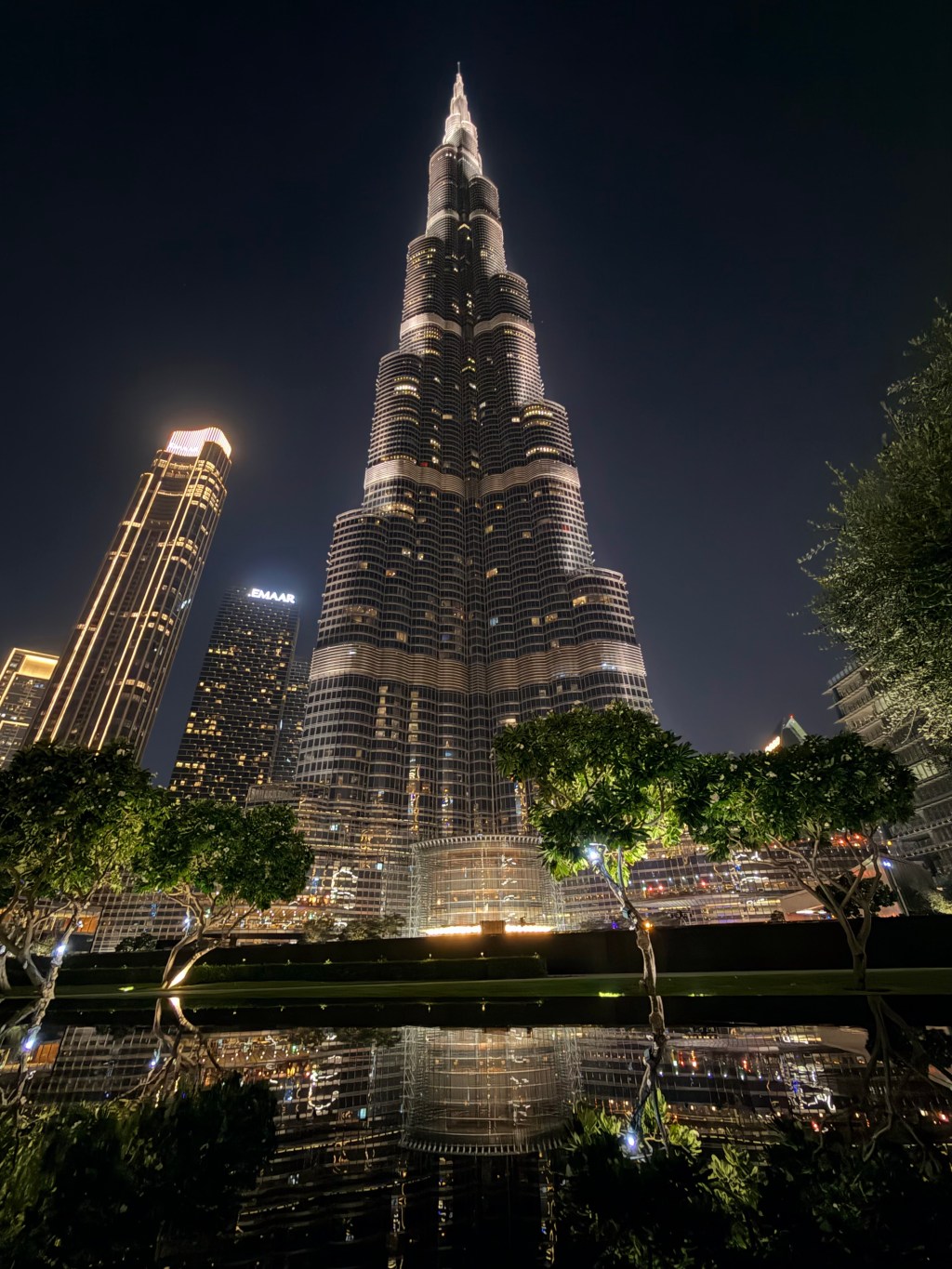
Dubai offers an unusual answer to this question. When we look at Dubai, we do not simply see a city. We see an image of a city: the Burj Khalifa rising from the desert, Palm Jumeirah extending into the sea, Ski Dubai operating in the middle of a desert climate, the Museum of the Future projecting an image of tomorrow, vast shopping malls, and a skyline illuminated at night.
In other words, Dubai is not merely a place to be inhabited; it is a place to be seen on a global scale.
Perhaps Dubai’s greatest achievement lies precisely here. It has not simply built a city in the desert. It has built an image of a city.
Capital Is No Longer Looking Only for Space
Globalization has fundamentally altered the role of cities. In Saskia Sassen’s conception of the global city, cities are no longer simply places where people live. They are strategic nodes through which finance, knowledge, services, and capital circulate on a global scale.
Dubai is one of the most striking examples of this transformation. Through financial centers, free zones, tourism, logistics, real estate, and large-scale development projects, it has positioned itself as a major destination for global capital.
Yet Dubai has done more than attract capital.
It has created a spatial environment in which capital can make itself visible.
This distinction matters. In contemporary capitalism, it is no longer enough for a city to be investable. It must also be desirable, talked about, photographed, shared, and recognized globally.
Dubai has brought economic capital and aesthetic visibility together within the same urban strategy.
Why Does the Burj Khalifa Matter So Much?
If we think of the Burj Khalifa merely as a skyscraper, we miss an important part of Dubai’s strategy.
Its significance lies not simply in its height, but in its capacity to represent Dubai in a single photograph taken almost anywhere in the world.
The same is true of Palm Jumeirah, Burj Al Arab, and the Museum of the Future.
These are not merely buildings or urban projects.
They are symbols.
When a tourist thinks about Dubai, when an investor evaluates the city, or when a social media user posts an image of it, the mental image of Dubai is constructed largely through these symbols.
This is where Pierre Bourdieu’s concept of symbolic capital becomes particularly useful. Economic resources can be transformed into symbols that generate recognition, prestige, and legitimacy.
Dubai’s architecture therefore functions as more than physical infrastructure.
It is also a form of capital that produces reputation.
Baudrillard’s Dubai
Jean Baudrillard’s concept of hyperreality offers perhaps one of the most revealing ways to understand Dubai. For Baudrillard, there comes a point in modern society when representation begins to precede the reality it supposedly represents. People increasingly engage not with reality itself, but with its produced, aestheticized, and consumable image.
In Dubai, this process becomes almost physical.
You can ski in the middle of a desert.
Artificial islands extend into the sea.
Nature is redesigned and transformed into real estate.
The future is presented architecturally before it has actually arrived.
Ski Dubai is perhaps the simplest example: outside, there is desert heat; inside, there is snow. Palm Jumeirah offers an even more striking illustration, turning nature itself into a redesigned and consumable spatial environment.
At this point, we are no longer simply producing an authentic experience.
We are producing a more attractive, more aesthetic, and more consumable version of reality.
In Dubai, simulation does not necessarily replace reality.
Reality itself is increasingly redesigned according to the logic of simulation.
The City Is Now Experienced on the Screen First
Guy Debord’s concept of the society of the spectacle helps explain another dimension of Dubai. For Debord, the spectacle is not simply an accumulation of images; it is a social relationship mediated through images.
Dubai’s global circulation makes this particularly visible.
The Burj Khalifa at night. An aerial view of Palm Jumeirah. Dubai Marina. Desert safaris. Luxury restaurants. The Museum of the Future.
These images do more than show Dubai.
They also tell us how Dubai is meant to be seen.
The city is continuously photographed, shared, circulated, and reproduced. As a result, part of Dubai now exists not in its physical geography, but in its digital circulation.
Dubai is therefore seen before it is visited.
And this points to an important transformation in contemporary urbanization: the value of space can no longer be explained solely through use value. Visibility itself produces value.
The more a place can be seen, shared, discussed, photographed, and transformed into a global symbol, the more valuable it can become.
One of the central findings of the study is precisely this shift: in Dubai, the meaning of space increasingly moves from use value toward visibility, representation, and digital circulation value.
Dubai Is Not Selling Investors Only the Present
This spectacle does not exist only in tourism advertising.
Dubai’s FDI reports repeatedly employ terms such as “future,” “innovation,” “global hub,” “world-class,” and “talent.” The increasing prominence of “future,” “innovation,” and “talent,” particularly after 2020, is especially noteworthy.
Dubai is no longer simply telling investors, “Invest here.”
It is making a more ambitious claim:
“The future is being built here.”
This is an important shift.
Investors are not presented only with Dubai’s existing economic capacity. They are also presented with a future that has not yet arrived.
“Future-ready economy.”
“Global hub.”
“World-class.”
These expressions do more than describe economic performance. They construct an image of Dubai’s future.
Dubai, therefore, is competing not only with the present of other cities.
It is competing with their futures.
But What Lies Behind the Showcase?
This is where the more unsettling dimension of Dubai’s story emerges.
No spectacle creates itself.
Behind Dubai’s hyper-modern urban image lies a vast labor organization spanning construction, cleaning, hospitality, tourism, logistics, and services, much of it sustained by migrant labor.
We see the skyscrapers, but not the labor that built them with the same intensity. We see the luxury hotels, but much less of the labor processes that keep them running. We see the shopping malls, while the labor sustaining this consumption economy is often pushed outside the frame.
Henri Lefebvre’s theory of the production of space is particularly useful here. Space is not neutral. Who becomes visible and who remains invisible; who occupies the center and who is pushed to the margins; who has access to particular spaces and which forms of labor are represented—all of these questions concern how space itself is produced.
Dubai’s spectacular image and its less visible labor world are therefore not separate realities.
Spectacle and invisibility are two sides of the same spatial system.
Culture Is Part of the Same System
Dubai’s strategy is not limited to finance, real estate, and tourism. Museums, art events, Expo, cultural organizations, and iconic architectural projects have also become part of the city’s global identity.
Because today, being wealthy is no longer enough for a city.
It must also appear modern.
It must appear innovative.
It must appear cosmopolitan.
It must appear to belong to the future.
This is where cultural capital enters the picture.
Culture is no longer simply culture. It can also generate prestige, legitimacy, visibility, and international recognition.
Economic capital can be transformed into symbolic capital through cultural and architectural representation.
Dubai is therefore not only accumulating capital; it is producing the meaning of capital.
So What Is Dubai’s Real Product?
Skyscrapers?
Luxury?
Tourism?
Real estate?
Finance?
Perhaps all of them.
But beneath them lies a more abstract product:
Dubai itself.
Dubai as an investment destination.
Dubai as a luxury lifestyle.
Dubai as an image of the future.
Dubai as a social media spectacle.
Dubai as a space of prestige.
Dubai as a global brand.
This is why reading Dubai simply as a “successful city” is insufficient.
Dubai is a laboratory in which we can observe how global capitalism aestheticizes space, transforms capital into spectacle, and converts visibility into economic value.
Capital transforms space.
Space becomes spectacle.
Spectacle enters digital circulation.
Digital visibility generates symbolic capital.
Symbolic capital feeds back into economic attractiveness.
And the cycle begins again.
Perhaps this is why the question we ask about cities needs to change:
Is a city valuable because of how usable it is—or because of how visible it is?
Dubai offers a striking answer:
In the twenty-first century, some cities are built not only to be lived in, but to be displayed to the world.
And perhaps this is where Dubai’s deeper story begins:
What has been built in the desert is not merely a city, but a showcase through which global capitalism makes itself visible.


Bir Cevap Yazın