The Second Body of Leadership
In 897, one of the strangest trials in history took place.
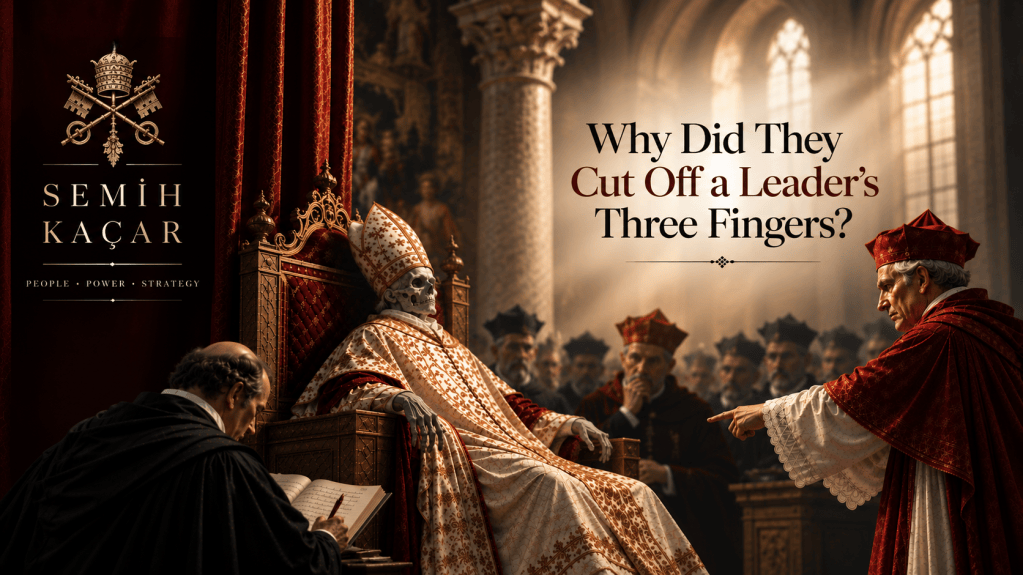
About nine months after his death, Pope Formosus was exhumed from his grave. He was dressed once again in papal vestments, seated on the papal throne, and brought before a court.
He was declared guilty.
His decisions were declared invalid. His appointments were revoked. Three fingers he had used in consecration were cut off.
At first glance, the episode may seem like a dark and bizarre anecdote from the Middle Ages. Yet what happened to Formosus points to a deeper issue that corporate boards and those overseeing CEO transitions should recognize today.
Because the person on trial was not the only thing at stake. The authority and legitimacy he represented were under attack as well.
No company today digs up a former CEO’s corpse and puts it on trial. Yet new CEOs often encounter something more invisible:
the leadership of their predecessors, still alive within the organization.
When a CEO’s tenure ends, we tend to assume the organization changes with them. Often, what does not change is precisely what they left behind: the leadership order.
A NEW LEADER DOES NOT SIT IN AN EMPTY CHAIR
Past leadership can continue to shape the reference points against which today’s decisions are judged. Over time, ways of making decisions, measures of success, rewarded behaviors, accepted levels of risk, relationships of trust, and ideas about what constitutes legitimate leadership can all leave a lasting imprint on an organization.
Bednar and Brown’s work on “organizational ghosts” shows how former leaders, even after they have left the organization, can continue to influence present-day behavior through reconstructed experiences and narratives.
That is why a new CEO does not, in fact, sit in an empty chair. They step into a leadership order shaped before they arrived.
Succession, then, is not simply about choosing the right leader. It is also about whether the new leader can read and manage the leadership order that already exists—and continues to shape the organization.
And that order is too broad to be explained by culture alone.
There is more concrete evidence that succession is not merely a human resources process. Research published by Claudio Fernández-Aráoz, Gregory Nagel, and Carrie Green in Harvard Business Review suggests that poorly managed CEO and senior-executive transitions at S&P 1500 companies may be associated with nearly $1 trillion in annual lost market value. The cost of a leadership transition, in other words, does not end with finding the next executive. A poorly managed transition can also affect an organization’s ability to create value.
According to a McKinsey synthesis of several studies, between 27 and 46 percent of senior executive transitions are regarded as failures or disappointments two years later. In the same body of research, 68 percent of leaders reported that the most difficult aspects of transition involved politics, culture, and people. These findings suggest that leadership transitions cannot be explained solely by the capabilities of the incoming executive; the organizational context into which that leader steps also matters.
This is why, in succession, the question “Who is the new leader?” clearly matters. But it is not enough.
Another question matters just as much:
“What is the new leader actually inheriting?”
Much of the succession literature focuses on selecting the right CEO, preparing that person for the role, and managing the transition itself.
This article focuses on a different question: What, exactly, is the new CEO inheriting once they take office? Because the challenge facing a new leader is not simply that the chair is empty.
The chair is occupied—by the past.
LEADERS LEAVE. THE ORDER REMAINS.
With a new leader often come new strategies. New goals are set. New executives take their positions. Yet the invisible side of the organization does not change at the same pace.
To understand this order, it helps to distinguish between two dimensions of leadership.
The visible dimension consists of the organizational structure, strategy, processes, performance systems, job definitions, and formal decision-making mechanisms.
A new leader can directly intervene in many of these.
But there is also an invisible dimension.
It lives in notions of legitimacy, leadership norms, decision-making criteria, unwritten rules, employee expectations, symbols, stories, and the shared world of meaning within the organization.
This is where the real difficulty begins. Over time, the invisible dimension can harden into assumptions that no one questions.
At some point, people stop asking, “Why do we do things this way?” They simply say:
“This is how things are done here.”
The strongest resistance a new leader faces is sometimes not open opposition.
It is the unquestioned norm.
When Jack Welch stepped down as CEO of General Electric in 2001, he had led the company for more than two decades. For his successor, Jeff Immelt, the challenge was not simply to develop a new strategy. It was to lead GE after Welch.
In Hot Seat, which Immelt wrote with Amy Wallace, he recounts an anecdote from just before he took over. In the locker room of a golf club, someone asked him what he did for a living.
“I work at GE,” he said.
The man immediately replied:
“GE? Jack Welch! I feel sorry for the guy who has to replace him.”
The brief story Immelt tells captures the invisible comparison a new CEO can face with striking clarity.
Welch was not simply a CEO. The performance philosophy, leadership standards, and decision-making practices that took shape during his tenure had become reference points for GE.
Immelt’s challenge was not merely to develop his own strategy.
It was to establish his own leadership in an environment where Welch’s definition of success was still alive in the organization’s collective mind.
The former leader was physically gone. But the definition of “success” formed during his tenure remained.
This is where the relationship with the past becomes critical. A new leader can choose either to preserve the predecessor’s legacy largely intact or to erase the past altogether. Yet every organization contains elements of its past that are worth preserving—and others that need to be transformed.
A culture of trust, institutional knowledge, a shared sense of purpose, and ethical principles may be strategic assets worth carrying forward. By contrast, decision-making mechanisms dependent on a particular individual, practices that once worked but have lost their relevance, or habits sustained simply because no one questions them may need to change.
The transformation of IBM that Lou Gerstner describes in Who Says Elephants Can’t Dance? offers an instructive example. Gerstner explains how he adapted IBM’s strategy and organizational structure to changing competitive conditions while keeping the company together and redeploying its strengths in a new strategic direction. He preserved the organization’s technical capabilities and institutional knowledge while changing how those strengths were used.
The important point is that Gerstner did not reject IBM’s past wholesale. He preserved the strengths that helped sustain the organization while changing ideas and practices that had ceased to serve it.
Managing the past does not mean preserving it unchanged.
The real question is what from the past is worth carrying into the future.
Good succession does not freeze the past.
It redefines what the past means for the future.
So what do we call all of this?
THE SECOND BODY OF LEADERSHIP
In The King’s Two Bodies, Ernst Kantorowicz argued that a monarch has two bodies.
The first was the natural body: it was born, aged, and died.
The second was the political body: it represented office, authority, and continuity.
When the monarch died, the natural body disappeared; the political body lived on.
This idea is remarkably useful for understanding leadership transitions in organizations today. When a leader’s physical presence disappears, the order that leader created within the organization does not necessarily disappear with it.
Decision-making norms, measures of success, stories, rituals, and unwritten rules can persist. So can the shared beliefs people hold about “how things are done here.”
Management and organization research explains different parts of this persistence through different concepts. Walsh and Ungson’s work on organizational memory shows how past experiences can be retained within organizations and retrieved for future use. Weick and his colleagues explain how the past is interpreted in the present through the process of sensemaking. Sydow, Schreyögg, and Koch show through path dependence how processes formed in the past can shape the options available in the present. Bednar and Brown’s work on “organizational ghosts” shows how former leaders and past experiences can continue to influence present-day behavior even after those leaders are no longer part of the organization.
Each of these concepts makes an important part of the picture visible. But when a new leader takes office, they do not encounter these forces separately. They encounter a single organizational reality in which institutional memory, past decisions, employee expectations, unwritten rules, standards of legitimacy, and the influence of previous leadership eras have become intertwined.
That integrated reality is what I call the Second Body of Leadership.
The concept is not intended to replace existing literature with a new explanation. It is a management framework for making visible how elements explained separately across different streams of research can converge during a leadership transition and take shape as the leadership order the incoming leader encounters.
And this order is not created solely by the legacy of the most recent leader. One CEO may establish a discipline around performance, a successor may embed a particular conception of growth, and another may institutionalize norms around innovation. Over time, these layers accumulate. Some are preserved, some fade, and some are reinterpreted under new circumstances. But together, they can form a broader order that shapes the incoming leader’s decisions and the boundaries within which their leadership is regarded as legitimate.
What a new leader inherits, therefore, is not merely a position.
It is a leadership order accumulated over time.
That is the crucial distinction: leadership legacy explains what remains from the past. The Second Body of Leadership explains how those remaining effects combine with memory, norms, legitimacy, and decision patterns to confront the incoming leader as a lived organizational reality.
Succession, therefore, is not simply about replacing one leader with another.
It is a transition from one leadership order to another.
MANAGING THE SECOND BODY OF LEADERSHIP
Every new leader steps into a leadership order that existed before they arrived. The challenge is not to preserve that order exactly as it is or to reject it entirely. It is to read it accurately, determine what should be preserved and what should be transformed, and establish the legitimacy of the new leadership within that order.
One way to do this is through a four-step approach: diagnose, reinterpret, legitimize, and transfer forward.
1. Diagnose the Second Body
When new leaders take office, they typically examine the organizational chart, financial results, and performance metrics. These are necessary, but they reveal only the organization’s visible structure. Understanding the Second Body of Leadership also requires looking at the invisible structures that continue to live within the organization.
That structure resides in unwritten rules, decision-making habits, and collective memory. Decision paths that once produced success can, over time, become accepted as inherently right simply because no one questions them. Employees may then begin making decisions not only according to the conditions of the present, but also according to a conception of leadership that was regarded as legitimate in the past.
For that reason, the new leader’s first task is not simply to learn the organization’s history. It is to discover how the organization makes sense of the world.
These questions offer a useful starting point:
- Whom, which principles, or which past experiences do employees refer to when making decisions?
- What behaviors are associated with success?
- Which practices are accepted as right without being questioned?
- What stories, symbols, and rituals does the organization use to define itself?
- What kind of leadership is currently regarded as natural and legitimate?
- Which leader, although no longer in the organization, continues to influence decisions?
The answers reveal not the organization’s formal structure, but its Second Body of Leadership.
An undiagnosed second body cannot be managed.
Jeff Immelt’s initial challenge at General Electric is instructive in this respect. The issue facing him was not simply developing a new strategy, but recognizing that the performance philosophy and decision-making criteria shaped during Jack Welch’s tenure were still serving as organizational reference points.
Leader Note: Do not spend your first 90 days examining only financial results and the organizational chart. Map the organization’s Second Body of Leadership: systematically analyze its stories, decision-making references, unwritten rules, symbols and rituals, rewarded behaviors, and prevailing notions of legitimate leadership.
2. Reinterpret the Second Body
Diagnosis is only the beginning.
The real question is:
What will I preserve, and what will I transform?
No leader begins with a blank page. An organization’s culture of trust, shared purpose, ethical principles, and institutional knowledge built over time may be powerful assets worth carrying into the future. At the same time, decision-making mechanisms dependent on particular individuals, habits that continue simply because they have never been questioned, and practices that worked only under past conditions can become obstacles to change.
The transformation of IBM described by Lou Gerstner in Who Says Elephants Can’t Dance? offers an instructive example. Gerstner preserved IBM’s technical capabilities and institutional knowledge while repositioning them for changing competitive conditions. In doing so, he preserved the organization’s strengths while redefining what those strengths meant within the organization.
The new leader’s task is not to fight the past, but to reconstruct its meaning.
For every element of the legacy, three questions can be asked:
What will we preserve?
What will we transform?
What will we leave behind?
Good succession does not freeze the past.
It redefines what the past means for the future.
Leader Note: Before initiating change, make explicit which values should be preserved and which habits should be transformed. Building the right relationship with the past requires knowing not only what to carry forward, but also what to leave behind.
3. Legitimize the Second Body
When a new leader takes office, it is not simply a new executive who appears. The leadership order inherited from the past now comes into contact with the leadership philosophy the new leader wants to establish.
At this point, legitimacy is created not through declarations, but through choices.
The first appointment.
The first promotion.
The first crisis.
The first reward.
The first concession.
The first “no.”
Each sends the organization an answer to the same question:
“What does this leader really believe?”
A leader may advocate learning. But if promotions consistently go to those who know the most rather than those who learn the fastest, the organization takes its real message from the promotion system.
A leader may advocate collaboration. But if managers are rewarded solely for the results of their own teams, the stated philosophy and the actual leadership model begin to diverge.
Satya Nadella’s transformation of Microsoft is instructive in this regard. In Hit Refresh and in Microsoft’s own corporate narrative, there is a clear emphasis on moving from a “know-it-all” approach toward a “learn-it-all” mindset, with greater emphasis on growth mindset, curiosity, and collaboration. What matters is not simply articulating this philosophy, but embedding it in the systems, decisions, and behaviors that employees experience every day.
Because organizations turn leaders’ repeated behaviors into norms more readily than they absorb leaders’ statements.
Leader Note: Your first decisions shape not only the present, but also the leadership philosophy the organization will regard as legitimate in the future. Design your early appointments, your response to the first crises, and the behaviors you reward to reflect the leadership approach you want to establish.
4. Transfer the Second Body Forward
The Second Body of Leadership is not only something inherited from the past. It is also something carried into the future.
Today’s decisions become tomorrow’s organizational memory. Today’s rituals shape tomorrow’s culture. Today’s rewarded behaviors become tomorrow’s norms. The managers developed today carry tomorrow’s leadership philosophy.
Another responsibility of the new leader, therefore, is to consciously shape the Second Body of Leadership that the next leader will inherit.
To do this, leaders:
- create new stories of success that reinforce the organization’s shared purpose,
- develop rituals that make values visible,
- institutionalize decision-making principles,
- make learning and leadership development part of organizational continuity,
- build a leadership order that can endure beyond their tenure.
Harvard Business School’s case on General Electric and research on Crotonville show that, during Jack Welch’s tenure, developing leaders was treated not simply as an HR practice but as part of organizational continuity. The structure Welch helped build served to transmit a particular understanding of leadership beyond his own era.
The ultimate question of leadership, then, is no longer simply:
“What did I accomplish while I was in charge?”
The harder question is:
“What will continue to live within the organization after I leave?”
Leader Note: Do not measure your success only through today’s performance metrics. Consciously design which values, decision-making principles, and leadership philosophy will continue to live within the organization after you are gone.
THE LEADERSHIP THAT REMAINS
Returning to the story of Pope Formosus, what happened after his death was an attempt to erase the past. But the attempt did not last. Later popes invalidated the decisions of the Cadaver Synod; the validity of the consecrations performed by Formosus was restored, and his body was reburied at St. Peter’s. Michael Edward Moore examines the political and religious struggles surrounding that body in detail in The Body of Pope Formosus.
More than a thousand years have passed. History changed. Institutions changed. Ideas about leadership changed.
But the assumption that changing a leader means eliminating the past did not.
Today, when a new CEO takes office, they inherit more than a position. They step into a leadership order shaped by decision patterns, measures of success, relationships, norms, symbols, and ideas of legitimacy that existed before them.
That order can be neither preserved in its entirety nor erased by a single decision.
This is why one of the new leader’s most important responsibilities is to see the Second Body of Leadership they have inherited and decide what it should become.
Because a new leader does not sit in an empty chair.
They step into a leadership order shaped before they arrived.
Leadership begins when they start deciding which parts of that order should live on, which should end, and which should acquire a new meaning.
 Semih kaçar
Yorum bırakın