Syrian Women and Modernity’s Uncomfortable Question
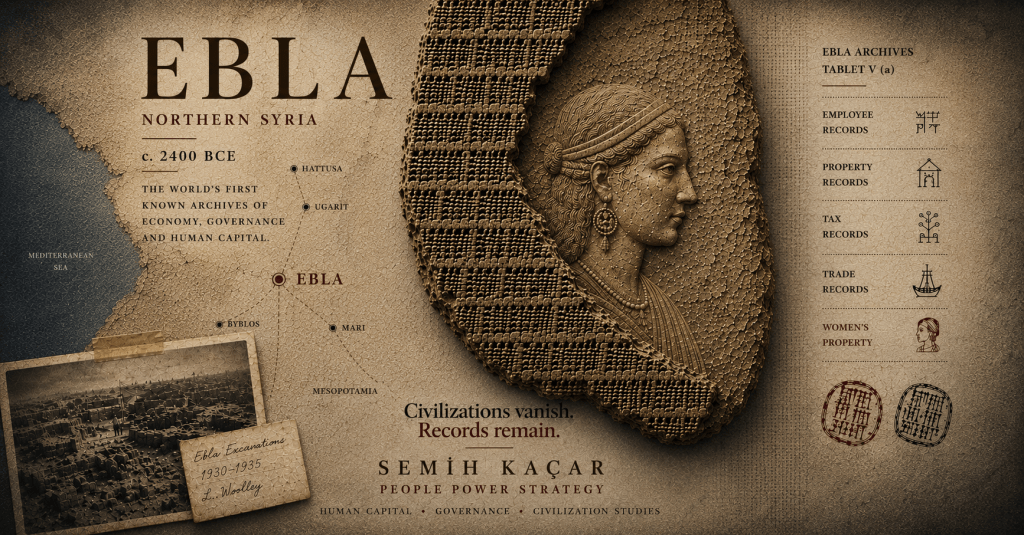
A world that organizes conferences on women’s participation in economic life often fails to realize that women’s economic activities were being recorded in Syria nearly 1,700 years before the founding of Rome.
The modern world likes to tell flattering stories about itself.
It tells the story of women’s participation in economic life as a triumph of modernity.
It presents corporate governance as a product of the Enlightenment.
It portrays state capacity as an achievement of the Industrial Revolution.
Then history quietly places a clay tablet before us.
Ebla.
2400 BCE.
A city-state that once rose in Tell Mardikh, in what is now northern Syria.
In the 1970s, excavations led by the Italian archaeologist Paolo Matthiae brought nearly 17,000 clay tablets to light.
These tablets did not merely record the wars of kings.
They recorded personnel.
The allocation of resources.
Commercial agreements.
Taxation.
Diplomatic correspondence.
In other words, nearly 4,500 years ago, people were already documenting some of the earliest examples of what we now call human resources, public administration, and governance.
And yes, women were there too.
Not at the margins of history.
Inside the records.
Inside the economy.
Inside production.
Inside systems of property and ownership.
These tablets contain references to women’s property, economic activities, roles within palace administration, and public responsibilities.
Some took part in production.
Some were involved in the management of economic resources.
Others appeared in official state records under their own names.
Now consider the scale of time.
Rome would not be founded for another 1,700 years.
Athens’ Golden Age was still nearly 2,000 years away.
The English Parliament lay more than 3,500 years in the future.
Magna Carta would not be signed for another 3,600 years.
Women in many countries would wait another 4,300 years before gaining the right to vote.
Many of the institutions and political structures we celebrate today as symbols of civilization did not yet exist.
Yet the scribes of Ebla were already documenting economic life, property relations, trade networks, and social organization.
And this is where the irony of history begins.
Because when we read these records today, we are surprised.
We are surprised that a woman’s economic activity was recorded 4,500 years ago.
We are surprised that a woman could own property.
We are surprised that a woman could appear in official state records.
But let us pause for a moment.
What exactly are we surprised by?
The existence of a city?
The discovery of a tablet?
Or the possibility that the past may not have been as foreign as we imagine?
Because the women of Ebla do not challenge what we know about history.
They challenge what we think history is.
We have grown accustomed to imagining the past through its absences.
Less freedom.
Less development.
Less technology.
Less rights.
Less visibility.
And yet these women emerge from records written 4,500 years ago and stand before us.
As property holders.
As economic actors.
As producers.
As participants in administration.
And inevitably, a question arises:
Who are we really surprised by?
The women of Ebla?
Or ourselves, for having imagined the past as something far simpler and far more uniform than it actually was?
Because what confronts us here is not merely the record of a woman.
It is something more unsettling.
We know of the economic existence of a woman who lived 4,500 years ago.
Because someone believed she was worth recording.
Someone believed her labor deserved to be seen.
Someone believed her existence belonged in the record.
And perhaps this is where the real question begins.
What surprises us more?
The existence of that woman?
Or the existence of a world in which her presence was ordinary?
That is why the women of Ebla are not merely an archaeological discovery.
They are a challenge that compels us to reconsider where the center of human history truly lies.
Because sometimes history is not the story of discoveries.
Sometimes it is the story of forgotten centers.
Perhaps history is not simply the story of particular eras and particular geographies, as we are often taught.
And perhaps the greatest irony of all is this:
Some of the ideas we celebrate today as symbols of progress once belonged to the ordinary realities of everyday life in places long forgotten.
For this reason, the women of Ebla do not belong only to the past.
They are a quiet question addressed to the present:
Is humanity truly discovering new truths?
Or is every generation merely rediscovering truths once known, only to give them new names of its own?
 Semih kaçar
Yorum bırakın