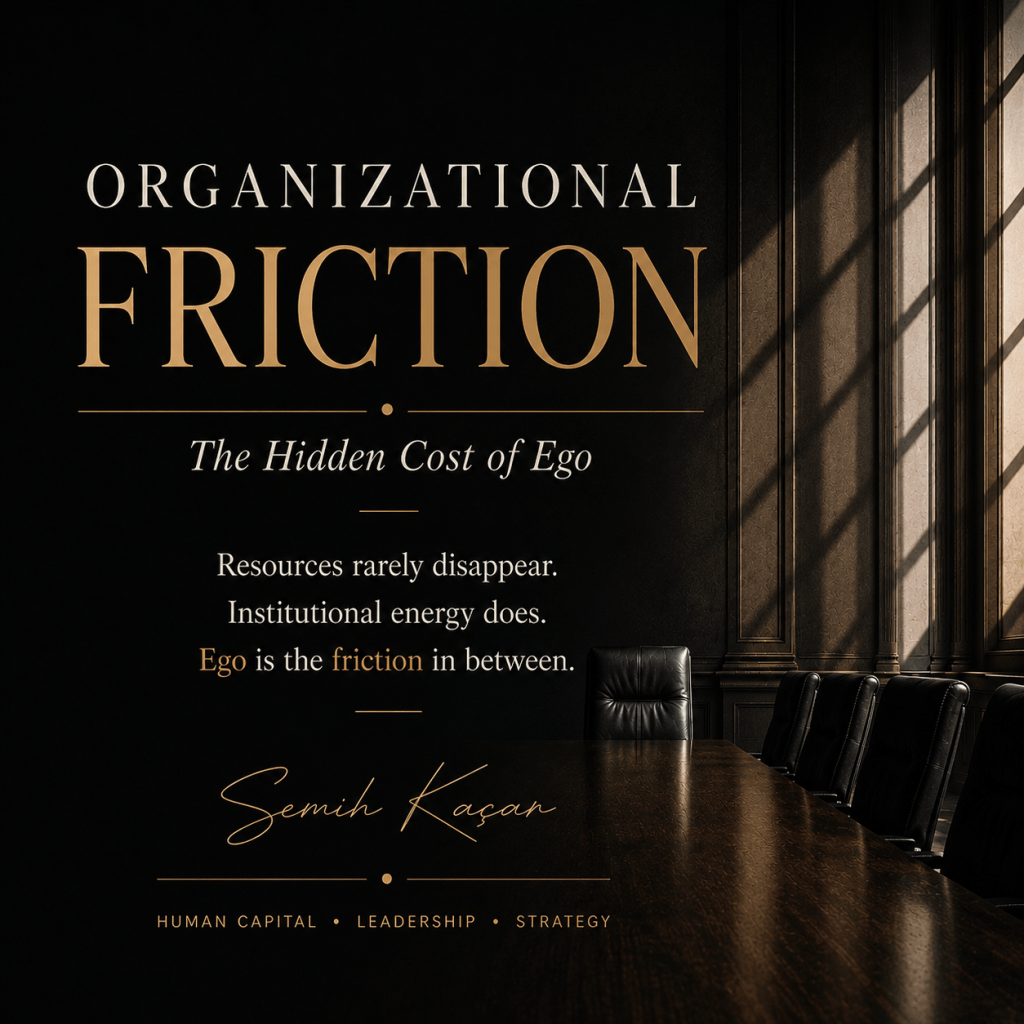
Organizational Friction
In physics, friction does not eliminate energy. It simply makes it more difficult for energy to be converted into motion.
Organizations operate under a similar principle.
Resources remain available. People remain in place. Technology remains accessible. Yet invisible costs can prevent an organization from converting its potential into performance.
So what truly determines an organization’s success?
Is it resources, budget, technology, or talent?
All of these matter.
Yet many organizations face an invisible constraint:
Their ego capacity.
As organizations grow, they often cease to struggle with resource scarcity and begin to struggle with power dynamics.
Meetings become arenas for position protection rather than decision-making. The delegation of authority is perceived as a risk. Ideas are evaluated not on their merit, but on who presents them. Success is increasingly attributed to individuals rather than the institution.
Over time, organizational energy is diverted away from solving external challenges and toward managing internal competition.
McKinsey’s long-running Organizational Health Index research consistently demonstrates that high-performing organizations are characterized by cultures built on trust and collaboration.
Organizations are rarely slowed by a lack of resources alone. More often, they are constrained by invisible costs that prevent those resources from being aligned toward a common purpose.
Ego is one of the most significant of these costs.
Ego does not reduce resources. It reduces an organization’s ability to convert resources into performance.
Harvard Business School professor Amy Edmondson’s research on Psychological Safety shows that high-performing teams are distinguished not by having the most talented individuals, but by creating environments where people feel safe to express ideas, concerns, and dissenting views.
In organizations where status anxiety dominates, people become more concerned with protecting their position than contributing their perspective.
As ego rises, learning capacity declines.
When people stop speaking, organizations stop learning.
When people stop asking questions, organizations stop improving.
When people become afraid to take risks, organizations stop innovating.
MIT Sloan School of Management professor Edgar Schein defines organizational culture as the collection of behaviors leaders pay attention to, reward, and tolerate.
In other words:
When ego is rewarded, ego grows.
When purpose is rewarded, institutions grow.
Management scholar James March argued that organizations are not merely structures, processes, and organizational charts. They are coalitions of individuals with different interests, aspirations, and priorities.
When the distance between institutional purpose and individual ambition widens, organizational energy is increasingly spent preserving internal equilibrium rather than creating value.
Strong organizations are not built by strong individuals alone. They are built by individuals capable of subordinating personal ego to a larger institutional mission.
One of the most significant findings in Jim Collins’ Good to Great research reflects precisely this principle.
The leaders of enduringly successful organizations were rarely the most charismatic individuals. Rather, they were what Collins called Level 5 Leaders—leaders capable of placing institutional purpose above personal recognition.
According to Collins, great organizations are not built by powerful egos. They are built by leaders united around a purpose greater than themselves.
Throughout history, great states, corporations, and institutions have not always declined because of resource shortages.
Often, the deeper problem has been the erosion of the balance between personal power and institutional purpose.
At a certain point, the greatest threat to an organization no longer comes from external competition.
It comes from expanding internal egos.
From this perspective, an organization’s true constraint is rarely its budget. It is not its technology. Nor is it the size of its workforce.
Its true constraint lies in the extent to which personal ego is allowed to eclipse institutional purpose.
Just as friction in physics does not destroy energy but dissipates part of it before it can become motion, ego in organizations does not eliminate resources—it prevents a portion of those resources from ever becoming performance.
Organizations rarely decline because they exhaust their resources. More often, they decline because they lose sight of their shared purpose.
And the true strength of an institution is not determined by how powerful its people are.
It is determined by the extent to which powerful people can unite around a common purpose.
Perhaps the question we should ask ourselves today is this:
Are our organizations truly being slowed by a lack of resources?
Or by the hidden costs of ego that quietly erode performance long before they appear on any balance sheet?
 Semih kaçar
Yorum bırakın