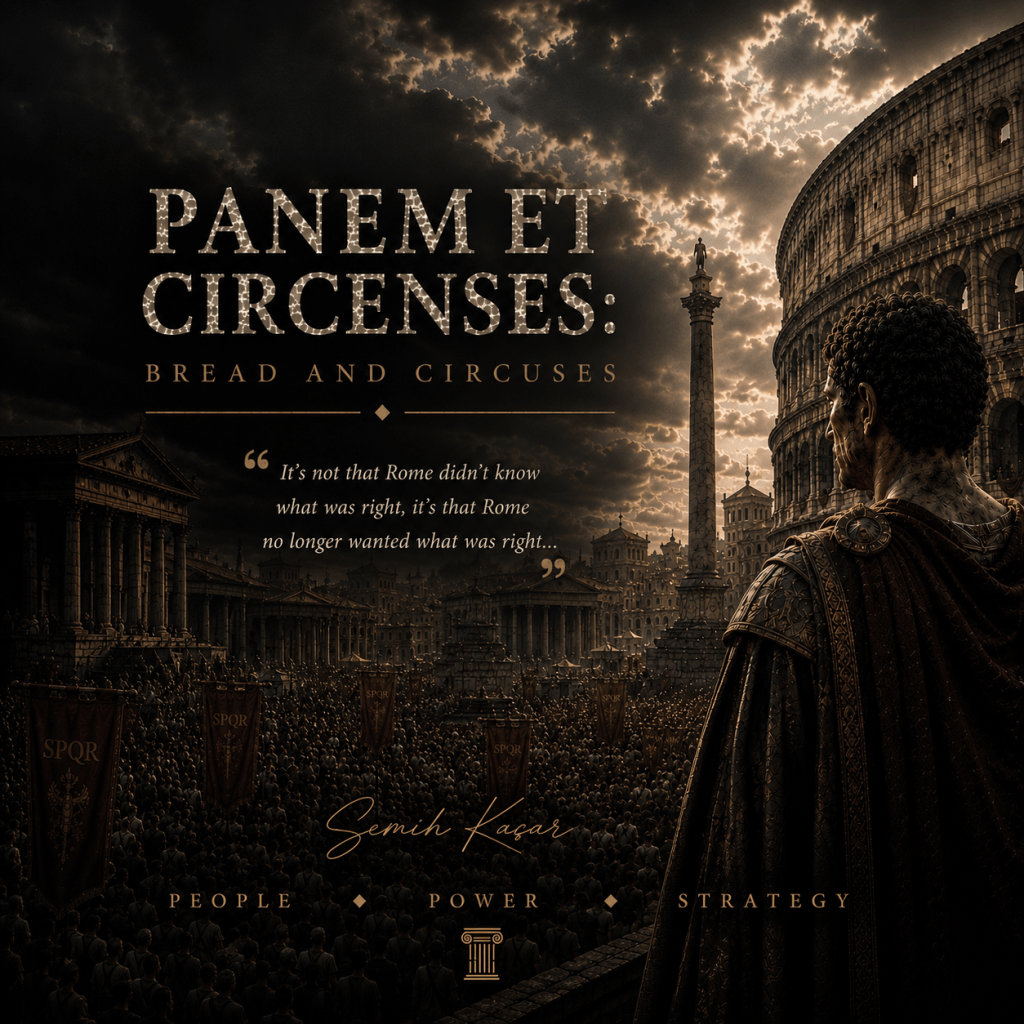
Nearly two thousand years ago, the Roman poet Juvenal captured a profound shift in society with just two words:
Panem et Circenses — Bread and Circuses.
In Juvenal’s view, the people of Rome were gradually drifting away from public affairs, civic responsibility, and the exercise of their freedoms. In their place emerged a growing appetite for comfort, entertainment, and spectacle.
Free grain distributions, gladiatorial contests, chariot races, and grand public performances dominated the civic landscape.
Yet Rome remained prosperous.
Its armies were formidable.
Its cities were magnificent.
What concerned Juvenal was not the spectacles themselves, but the changing priorities they reflected.
Because societies do not transform only when they lose wealth, power, or resources.
Sometimes they transform when they redefine what they consider worthy of attention.
That is why Panem et Circenses is not merely a story about Rome.
Societies are shaped not only by the resources they possess, but also by the values they elevate.
What a society chooses to admire, reward, and aspire to gradually influences individual ambitions, institutional priorities, and the direction of public life itself.
For this reason, understanding a society requires more than examining its economy, technological capabilities, or political institutions.
We must also pay attention to:
- What it celebrates,
- What it rewards,
- What it talks about,
- And where it directs its time, attention, and collective energy.
Because the future of societies is often determined less by the opportunities available to them than by the things they choose to value.
Perhaps this was precisely the point Juvenal was making two thousand years ago.
The question was not what Rome was occupied with.
The question was what Rome was becoming.
And today, are the priorities shaping our institutions, our societies, and our future the result of deliberate choice—or have they emerged gradually, without us ever fully noticing?
 Semih kaçar
Yorum bırakın