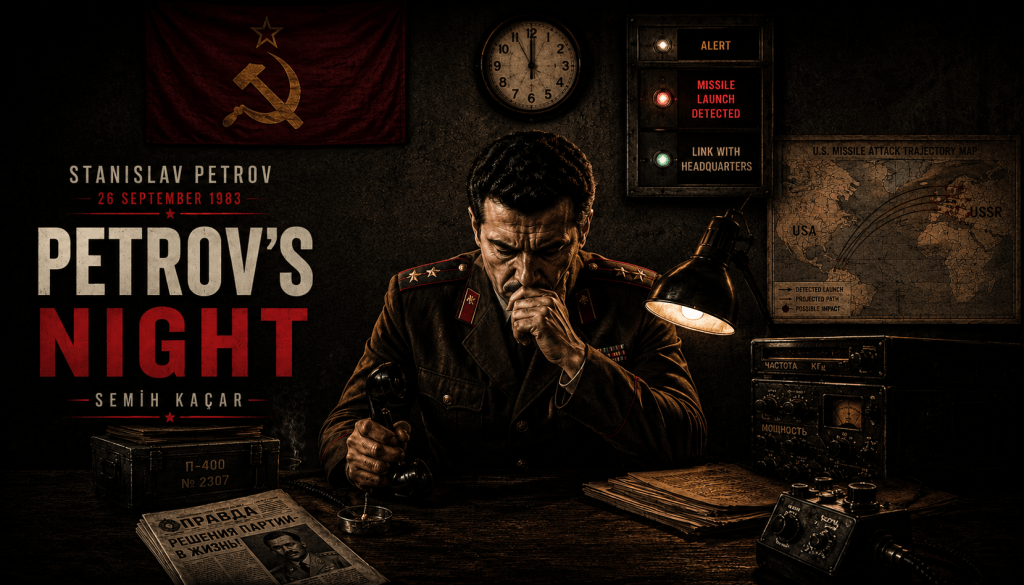
September 1983.
The world was passing through one of the most perilous moments of the Cold War. U.S. President Ronald Reagan had publicly branded the Soviet Union the “Evil Empire,” and whatever remained of mutual trust between the two superpowers had all but disappeared. The stability of nuclear deterrence depended not merely on the existence of nuclear weapons, but on the ability to make life-or-death decisions within minutes. In such an environment, early warning systems became one of the most critical pillars of military strategy.
On the night of 26 September 1983, the Soviet Union’s newly deployed space-based early warning system sounded an alarm.
The screens indicated that an intercontinental ballistic missile had been launched from the United States toward the Soviet Union.
Then came a second alert.
A third.
A fourth.
A fifth.
With every new warning, the possibility that the first signal was not a malfunction but the beginning of a genuine nuclear attack appeared increasingly credible.
That night, the duty officer on watch, Stanislav Petrov, found himself staring at screens that indicated the United States had launched a nuclear strike. If those readings were accepted as genuine, the report would reach the Soviet leadership within minutes, and what followed would no longer depend on a single officer’s judgment but on the decisions of an entire state. The danger lay not merely in the alarm itself. If the alarm was wrong, every decision built upon it could be wrong as well.
The alert originated from Oko, the Soviet Union’s newly commissioned space-based early warning system. Oko’s mission was to detect the infrared signature produced by the engines of American intercontinental ballistic missiles during the earliest moments of flight. By identifying a launch almost immediately, the system was designed to give the Soviet leadership a few precious extra minutes to decide how to respond.
But the information available to Petrov did not come from Oko alone.
The Soviet early warning architecture had been designed with a second layer of verification. While satellites detected the heat generated by a missile’s engines, ground-based radar systems were responsible for confirming the presence of the physical object itself as it traveled through space. That confirmation, however, required time. Because of the Earth’s curvature, a missile launched from the United States would not enter the radar horizon immediately. Under normal circumstances, radar confirmation was expected roughly twenty minutes after the initial satellite warning.
Petrov refused to classify the alarm as a confirmed attack.
In his judgment, the available information was still incomplete. Soviet doctrine required that satellite warnings be corroborated by ground-based radar before being treated as conclusive. That confirmation had not yet arrived.
There was another reason for his hesitation.
The system was reporting only five incoming missiles. Petrov found it strategically implausible that the United States would initiate a first nuclear strike with such a limited number of weapons. If a genuine first strike were underway, it would almost certainly involve a far larger and more devastating launch.
He therefore chose not to report the alarm as a confirmed nuclear attack.
Approximately twenty minutes later, the ground-based radar network detected nothing.
Subsequent technical investigations revealed what had actually happened. Sunlight reflecting off high-altitude clouds had been misinterpreted by Oko’s infrared sensors as the heat signature of missile launches.
The night that appeared to mark the beginning of nuclear war had, in reality, begun with nothing more than reflected sunlight.
If Petrov had reported the alarm as a confirmed attack, a single piece of erroneous data might have set the entire machinery of nuclear doctrine in motion during one of the most critical moments in human history. Decisions made within minutes could have altered not only the course of that night, but the future of humanity itself.
At its core, the entire story revolves around a single question:
When does a piece of information become reliable enough to justify a decision?
Petrov’s answer became more than a response to one extraordinary night. It offered a lasting lesson in how decisions should be made. He believed that the information before him was simply not sufficient to support a decision of such irreversible consequence.
Perhaps that is why Petrov’s story has never remained merely a historical episode of the Cold War. More than four decades later, it continues to resonate because what unfolded that night was not only a nuclear crisis—it was also a profound test of humanity’s relationship with information itself. Petrov acted differently not because he possessed the correct answer, but because he recognized that the information available to him had not yet been sufficiently verified.
The same principle continues to shape international politics today.
In November 2022, after a missile struck the Polish village of Przewodów, initial reports suggested that Russia might have launched an attack on NATO territory. Rather than acting on those first assessments, however, Poland, NATO, and allied governments waited for radar data, satellite imagery, and intelligence from multiple sources to be evaluated together. The subsequent investigation showed that the initial assessment had been incorrect and that the incident was not a deliberate Russian attack against NATO. A crisis that could have escalated into direct military confrontation between NATO and Russia ultimately followed a very different course because decisions were made only after the verification process had been completed.
The significance of the incident lay not in the missile’s origin, but in the way decisions were made. The first assessment was not accepted as definitive truth. Strategic judgment came only after independent verification. In essence, this was precisely the same reasoning Petrov had exercised forty years earlier.
Today, research on decision-making explains this form of reasoning through concepts that did not yet exist in 1983. Petrov knew none of their names. Yet his intuition was remarkably clear: before asking what the information said, he first asked how trustworthy that information actually was.
Perhaps the problem Petrov confronted was never unique to the Cold War.
More than forty years have passed. Early warning systems have evolved. Algorithms have become increasingly sophisticated. Artificial intelligence can now process volumes of data far beyond human capability. Today, many of our most consequential decisions are preceded not by human judgment, but by the assessment of a machine.
For that very reason, the defining question of the AI era is not whether algorithms are accurate.
The real question is this:
At what point should an algorithm’s output be considered reliable enough to justify a decision?
Algorithms do not produce reality. They produce assessments based on available data. Those assessments may be accurate, incomplete, or misleading. The quality of a decision therefore depends less on an algorithm’s technical accuracy than on the level of confidence with which its output is accepted.
The moment an assessment that still requires verification is treated as the decision itself, technology ceases to be merely a computational tool and becomes a source of institutional failure.
Recent history demonstrates that this is far more than a theoretical concern.
In Australia, the automated welfare compliance program known as Robodebt was introduced to detect irregularities in social security payments. The system automatically compared tax records with welfare data and calculated alleged debts based on discrepancies in reported income. Its underlying assumption, however, was that recipients earned income evenly throughout the year—a premise that proved false for thousands of people. Nevertheless, the algorithm’s conclusions were accepted as accurate. Hundreds of thousands of Australians received debt notices for money they did not actually owe. Eventually, the program was ruled unlawful, forcing the government to issue a formal apology and pay billions of dollars in compensation.
A similar pattern emerged in aviation.
In the two Boeing 737 MAX crashes of 2018 and 2019, the aircraft’s Maneuvering Characteristics Augmentation System (MCAS) repeatedly forced the nose of the aircraft downward after accepting faulty data from a single sensor without sufficient verification. As pilots struggled to understand why the system continued issuing those commands, they were unable to regain control. The two accidents claimed the lives of 346 people and became one of the clearest demonstrations of the consequences of allowing an automated assessment to occupy the center of critical decision-making without adequate validation.
Despite occurring in entirely different sectors, these cases shared the same underlying pattern. The problem was not that algorithms made mistakes. The problem was that institutions and individuals accepted an algorithm’s initial assessment as truth without sufficiently questioning it.
Decision psychology describes this tendency as automation bias—the human inclination to place greater trust in automated systems than in one’s own judgment. A system generates an assessment, and people gradually begin to treat that assessment not as a hypothesis requiring scrutiny, but as an established fact.
Viewed through today’s conceptual framework, Petrov did not succumb to automation bias. He did not reject the alarm. Neither did he accept the system’s initial assessment as unquestionable reality. Instead, he postponed judgment until the available information had been independently verified.
Today, this intellectual posture is often described as epistemic vigilance—the habit of questioning not only information itself, but also its reliability. That is precisely what Petrov demonstrated.
The problem was never that the system generated an assessment.
The problem arose when that assessment was allowed to replace the decision before it had been verified.
What makes the story even more remarkable is that Petrov had never heard of any of these concepts.
He did not reject the system.
Nor did he surrender his judgment to it.
He treated the system’s output not as a decision, but as a claim that still required verification.
Perhaps that is Petrov’s greatest legacy.
As technology advances, the importance of human judgment does not diminish.
It becomes even greater.
The greatest danger of the AI age is not that artificial intelligence will make mistakes.
It is that human beings will accept an AI-generated assessment as reality without subjecting it to sufficient scrutiny.
Technology will continue to evolve.
Algorithms will become increasingly sophisticated.
Yet no system can determine, on its own, whether its output is reliable enough to justify an irreversible decision.
That responsibility remains, as it always has, with human beings.
Perhaps that is why Petrov’s night never ended.
 Semih kaçar
Yorum bırakın