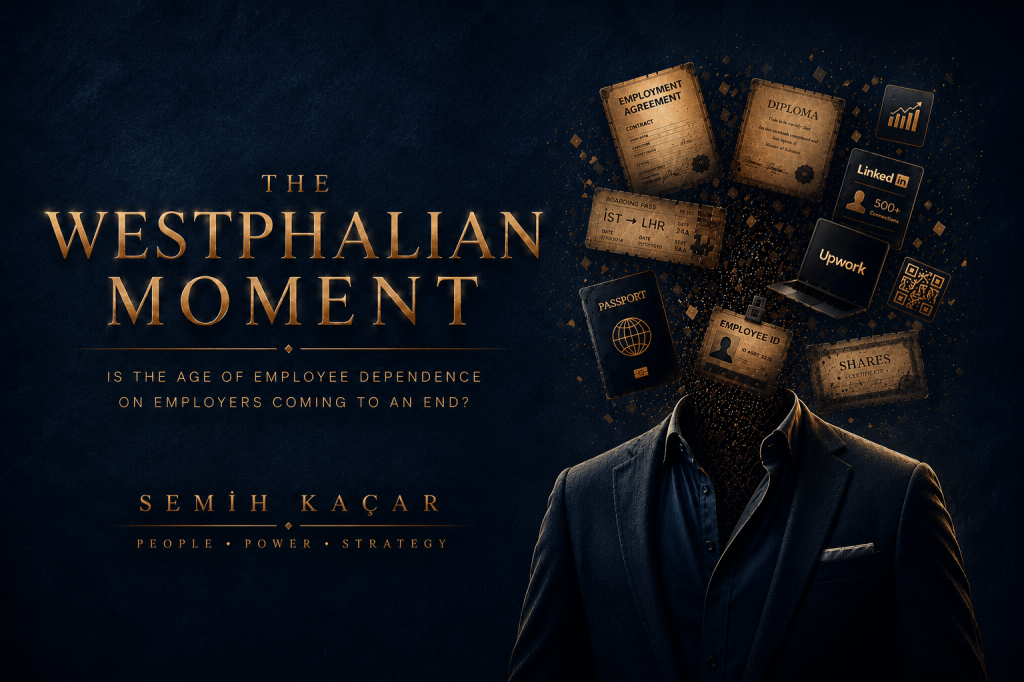
The significance of the Peace of Westphalia, signed in 1648, lies in more than its role in ending the Thirty Years’ War. What made it a genuine historical turning point was the recognition that the existing political order could no longer accommodate a new reality, making the construction of a new order both necessary and inevitable.
Every historical order is a product of the economic, social, and political conditions of its time. When those conditions change, institutions must reconsider not only their methods but also the fundamental assumptions that give meaning to their existence. Major historical transformations emerge not simply because tools or actors change, but because the institutional logic governing the relationships among those actors is fundamentally redefined.
This is precisely why the Peace of Westphalia occupies such a pivotal place in history. It did not create the modern state by itself; rather, it institutionalized a new conception of sovereignty upon which the modern state system would be built. The fragmented authority of the medieval order gave way to a political system in which sovereignty became concentrated in the nation-state. What changed was not merely the political actors, but the answer to a far more fundamental question: who holds sovereignty?
A transformation of comparable historical significance is unfolding today in the world of work. For the first time, the foundational assumptions upon which work has long been organized are being reshaped by profound economic, technological, and social forces.
Following the Industrial Revolution, economies of scale, mass production, and long-term employment relationships created the institutional environment in which Human Resources emerged. For nearly a century, HR was built upon a model in which employees were primarily committed to a single organization, careers developed largely within institutional boundaries, knowledge was generated and controlled by employers, professional development was directed by organizations, and professional reputation was closely tied to corporate identity.
In this sense, Human Resources is more than a managerial function responsible for managing people. It is also the governance model of a particular employment order. During a period in which organizations controlled access to knowledge, career opportunities, expertise, and professional reputation, HR evolved as the institutional mechanism through which this corporate order was managed.
Within this model, organizations were more than employers; they were the principal gatekeepers of knowledge, career progression, and professional development. HR systems were therefore designed to sustain and administer this institution-centered order.
Over the past two decades, however, the assumptions underpinning that order have begun to erode.
The internet democratized access to knowledge. Social media extended professional visibility beyond organizational boundaries. Remote work weakened geographical dependence. Platform economies expanded opportunities for work outside traditional employment structures. Artificial intelligence has now placed learning, knowledge creation, and expertise development directly into the hands of individuals on an unprecedented scale.
Today, a professional can simultaneously be an employee, a member of a global project team, an independent consultant, a digital content creator, and the manager of a personal brand. Career capital is increasingly accumulated not within organizations alone, but across broader professional ecosystems in which organizations are only one of many participants. This evolution closely reflects Manuel Castells’ theory of the network society. Castells argues that, in the digital age, economic and social power is organized less through hierarchical institutions and increasingly through networks. Likewise, careers are evolving away from institution-centered models toward distributed ecosystems built around professional networks.
For this reason, what is changing is far more than the way work is performed. For the first time, the institutional control that organizations historically exercised over knowledge, careers, professional reputation, and expertise is being systematically dismantled. Digital technologies and artificial intelligence are shifting many of these resources beyond organizational monopolies and into the hands of individuals. This development also aligns with Shoshana Zuboff’ analysis of how the digital age transforms economic and institutional power. Digitalization is not simply introducing new technologies; it is fundamentally redefining the balance of power between organizations and individuals.
Before Westphalia, political authority was fragmented; after Westphalia, sovereignty became concentrated within a single political entity. Today, the world of work is experiencing the reverse dynamic. Career opportunities, knowledge, and professional value are no longer concentrated within individual organizations but are increasingly distributed across professional networks, digital platforms, and individual capabilities.
From an HR perspective, this is not merely a technological shift. It is an institutional rupture.
Because what is changing is the balance of power between employees and organizations.
In the past, organizations were the primary architects of careers. Today, individuals are far less dependent on their employers to acquire knowledge, develop expertise, build professional networks, or even generate income. As Peter Cappelli has argued, modern careers no longer follow linear paths within a single organization. Instead, professionals increasingly build their careers across multiple organizations, projects, and capabilities. This reality calls into question many of the assumptions upon which modern HR has long been based.
The challenge, therefore, is not simply to integrate new technologies into HR processes. The more fundamental question is how the relationship between organizations and employees should be redefined.
Research across multiple disciplines points to different dimensions of this transformation. Castells demonstrates how power is increasingly organized through networks; Zuboff explains how digital technologies reshape economic and institutional power; and Cappelli shows that careers are moving beyond the traditional model of lifelong employment within a single organization. Taken together, these perspectives suggest that what we are witnessing is not merely a technological transition, but a structural paradigm shift that is redefining the foundational principles governing the relationship between organizations and employees.
Perhaps the central question facing Human Resources is no longer:
“How do we retain employees?”
The real question is this:
How can organizations remain trusted, desirable, and value-creating institutions when they are no longer the sole architects of people’s careers?
This question challenges not only the future of HR practices but also the future of the institutional paradigm upon which modern Human Resources has been built.
Westphalia redefined who held sovereignty. Today’s transformation of work is similarly redefining who creates career capital, knowledge, and professional value.
For that reason, the debate today is not simply about which technologies Human Resources should adopt. It is about how the institutional order that made modern Human Resources possible must be reconstructed in response to a new economic, technological, and social reality.
Perhaps this is why the era we are living through can rightly be described as Human Resources’ own Westphalian Moment.
 Semih kaçar
Yorum bırakın